Showing posts with label repair and reuse. Show all posts

Thursday, July 26, 2018

Cheap Tricks Series 1: Bohemian Earring.

Cheap Trick 1
Upcycled Bohemian Earrings by Rubieeh.


Am starting a Cheap Trick Series.!!!

What is this all about you ask!!?? 

Well, this is something I really enjoy and though share with you guys all these tricks, its all about changing something discarded or broken or useless, into something interesting and
something usefully. 
It's about giving a new life to something which is almost at the end of its use.

Reinventing
Renovating 
Recycling


In this post, I present to you this old & damaged discarded old Iron Box cord.
This was all ready to end up in the garbage, but it looked way too attractive to end up there!
It's a right thickness and manageable.


Cheap Trick 1 by Rubieeh
Discarded Electrical Cord.


Cheap Trick 1 by Rubieeh
Discarded Electrical Cord.

Just Check this out!


And this is what I converted it into!


Cheap Trick 1 by Rubieeh
Upcycled Bohemian Earring.


Cheap Trick 1 by Rubieeh
Upcycled Bohemian Earring


What do you guys think?
Is it a hit or a miss?
Leme know in the comments section below.
and if you would like to know the transformation process?

Wednesday, July 11, 2018

Sustainable Fashion and everything about it.


( That I know, lol ) 

'Sustainable' and 'Ethical' recently, have become popular words in the fashion industry. Every fashion brand,  producer, consumer, right about anyone involved in the process of creating fashion is urged to practice sustainability or put ethical practices into use.

 But what exactly is sustainable fashion?

According to the UN Report to World Commission on Environment and Development Sustainability is, 'meeting the needs of the present without compromising the ability of the future generation to meet their own needs.'

i.e we conduct our business- production, marketing, transportation etc in such a manner, that, the resources we are using benefits us, without the risk of exhausting it for the future generation. 


Sustainable Fashion


Sustainability in any industry depends on the three very significant pillars - Economic, Environmental and Social.

Also called the triple bottom line.

An industry can be regarded as sustainable only when it not only takes care of its economic progress and growth but also the social and environmental effect and wellbeing. 
So when we refer to ethical fashion we also are taking into account the same values as sustainable fashion.

From the cultivation of the cotton crop, for example, if is it free from pesticide and insecticide? is water management practiced? 
and when the cotton goes in for the dying process and other treatments, are the dyes organic? how is the wastewater treated? etc, is it chemical free? 
and then the actual process of garment making, where is it made? is it a safe and clean place for the workers? are they paid fair wages? are they exploited? is child labor involved? what is done with the production waste? are the garments made to last? 
And at each level fair wages have to be paid.
So in the entire process, not only is the economic aspect to be looked at but also the socio and environmental aspect have to be also taken care off in order for the business to be ethical.

These practices have become a very important cause of the pollution it causes which is greatly affecting the environment. Did you know the fashion industry alone contributes to 10% of global water pollution, which affects the marine lives as well as humans equally.
It was a wake-up call for the entire world, when the world 4th largest lake, Aral sea reduced to 10% of its original size cause of the cotton cultivation that started along the bank. 

In order to practice responsible business in the entire fashion industry, as a whole, 
   the Ethical Fashion Forum has put forward 10 criteria which define as ethical fashion and addresses the 3 pillars of sustainability. 


  1. Countering fast, cheap fashion. 
  2. Fair Trade. 
  3. Supporting sustainable livelihoods.
  4. Addressing toxic pesticide and chemical use.
  5. Using and/or developing eco- friendly fabrics and components. 
  6. Minimising water use. 
  7. Recycling and addressing energy efficiency and waste. 
  8. Developing or promoting sustainability standards for fashion. 
  9. Resources, training and/ or awareness raising initiatives
  10. Animal rights


A very interesting thing to note is the concept of sustainability and ethical Fashion is open to interpretation. It isn't rigid, in the sense, that only if the above-mentioned criteria are fulfilled by the company or factory or producer doesn't become an Ethical Brand. Fashion Organisations can adopt different ways to be Ethical, be it with respect to minimizing waste or minimizing environmental pollution by doing small and local business, etc.


A brand, if it decided to go ethical can also consider incorporating the following steps into its practice. 


  1. Employing women or certain ethnic groups
  2. Donating part of the profits to a charity
  3. Handmade
  4. Contributing to preserve traditions of an ethnic minority.
  5. Revealing manufacturing locations and workforce policies
  6. Natural Dyes
  7. Use of discarded fabrics.
  8. Upcycling of used materials.
  9. Made with recycled fabrics
  10. Garments made to last for a long time.

 An organization can choose to take these small steps in its functioning, if not all, cause we understand that everything can get a bit overwhelming and considering that our economy isn't sustainable yet, very expensive as well. Nevertheless, any step towards sustainability or ethical fashion should be always welcomed and appreciated.


Sustainable Fashion


All the given points cover the three pillar of sustainability, economic, environmental and social.

What they choose to follow, be it just one or all, is up to them, the producers.
We, as consumers, on our part have the responsibility to #ask the producer to be transparent about their practice.
Tell their consumers about how are the garments produced? how are the materials sourced? and what are the materials sourced? about worker well fair.


Sustainable Fashion

Ethical Fashion has to be a 2-way street,
 the producers need to take responsible steps and
 the consumers practice responsibly.


Friday, June 29, 2018

Plastic Free July!

Well, we don't have to stop just at July, It could become a part of our lifestyle!
That's what I aim to do.


Plastic Free.
Designed using Canva.


I recently came across the 'Plastic-free July Challenge' organized globally to raise awareness about the harmful effects of the single-use plastic. And found it a very interesting way to promote a plastic-free life. Everyone can try this challenge or take it as a form of a pledge without feeling too much pressure and take baby steps towards a Green living. 

The challenge is pretty simple, nothing hard and fast- we have the freedom to draw our own boundaries, the aim here is more to raise awareness and ultimately adopt a zero-waste lifestyle than to make things intimidating.
We have an option to choose what kind of challenge we take- it could be 1 day, 1 week, 1 month, a year, absolutely anything and also what we choose to stop using- all single-use plastic or the top 4 plastic pollutant- plastic straws, plastic bottles, plastic bag and coffee cups. or to have a plastic-free house, office space or travel. 
It could be also an individual or a group pledge!
you can customize the pledge as you feel convenient, to begin with. 


Plastic free
Designed using Canva.


It's a pretty easy, and very sensible challenging to take, considering the rampant use of plastic in our daily lives, the most harmful and excessive being the plastic shopping bags. 
In India, 20 states have completely banned the use, manufacturing, supply, and storage of polythene bags while 5 states have partial bans though we cant be very sure how far they have been successful, for the lack of awareness and also lack of an equally cheap substitute. 

Challenges or pledges like this will help create awareness and take personal steps to this cause.

 Step 1
Make a list of items that you use that are plastic based or harmful to the environment. 
Use of disposable coffee cups, plastic bottle, use of polythene bags, using disposable cutlery.

Step 2
What are the possible substitutes for it? 
What changes can you bring about in your lifestyle to reduce or avoid the complete use of it?  
Make a list of substitute or changes in lifestyle.  

Step 3

Make actionable plans to incorporate them into your daily life.
Adopting everything all at once might get a bit too overwhelming, and it would be convenient and much effective if actions are taken in small steps.

Step 4
Review. 
Give yourself time after which you can review your progress. And its okay if you are falling a bit behind, don't give up, even the smallest of progress is better than none.


For starters, we can
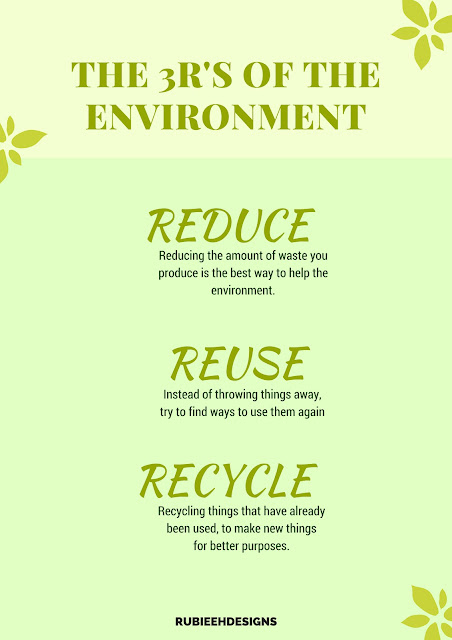
Reduce, the use where ever possible if not avoidable
Refuse, the use, but substituting it with eco-friendly options.
Reuse, if the item isn't sustainable.  
Avoid product in plastic packages.

Plastic Free.
Designed using Canva,

Wednesday, June 13, 2018

Beginners Guide to a Ethical Wardrobe. Part 2

How to create an ethical wardrobe?

My previous post was a brief introduction to what an ethical wardrobe is?
and to get an idea of how our fashion choices affect the environment?

I'll be using Ethical and Sustainable interchangeably 
for this series of posts, though they are two very different concepts. 
(A post specifically to talk more about this difference will be coming soon! ) 

So once we have understood what an Ethical wardrobe is,
creating it should not be very difficult. I have listed below few pointers to get you started! 


1. Take a nice look at your existing wardrobe.

Just because you are creating a new wardrobe, does not mean you have to get rid of the old and go on a mad shopping spree!!! Exactly the opposite in fact.
Open your closets, and check out all the clothes that you already own. There might be few gems lost and hidden away somewhere inside! Do you wear them all? Are there certain pieces kept for ages and ignored? 
well, it is time to clean it all up, give away the clothes that you no longer wear and are in wearable condition.
Some may be in good condition and just need a little touch from your local tailor, get it altered, a little fitting here or maybe a little loosing up there and it is as good as new.


2. Repair and Reuse.
Repair the small tears or loose stitches cause of which you have not been able to wear your fav pieces and get them back in your daily wear.
Clothes that are beyond the wearable condition, give it a go at DIYing it,
you can find some really amazing tutorials online!


3. Buy less, Choose well.
Go shopping only if you have to and need to, I know the 70% sale sign or the Buy 1 get 1 free deals all seem so irresistible.
But what we don't pay attention to is the quality of the clothes that we buy, is it stitched well, if the fabric of good quality or are these just going to get torn after few wears. 
Such impulse shopping only encourages the garment manufacturers to produce more low-quality garments, in subpar conditions of workers, they also put to use practices which create more waste and care less about how it is treated or disposed off.

( I know sad state of affairs. ) 


4. Try out Thrift shops or Vintage Shops.
Can't control that itch to shop, try out second-hand shops or vintage shops. As the saying goes, one man's food is another man's poison or the other way round, basically don't be quick to judge those pretty pre-owned pieces.  Sometimes we get tired of wearing clothes which might be in a perfect condition and these clothes go up for sale. There is no shame in buying second hand. Yes, they are Cheaper, that is a plus!!!
Buying a second-hand cloth means saving that piece of clothing from going to landfill and polluting the environment.


5. Shop Local. 
When we buy local, we help in reducing the pollution caused by transportation, empowering someone in our community and give back to the society and doing our little bit.
When I say Shop local, I don't mean, shops which get cheap stuff from a different city and sell it in ours. Shop Local products by local people or designers who use their traditional skill of weaving or embroidering or use fabrics that are locally made and manufacture clothing locally. This saves on transport pollution and creates a livelihood for the local community and also keep a tradition alive which otherwise seems to be vanishing in this fast fashion world.


Creating and maintaining an Ethical closet is all about thoughtfulness, towards out clothes, toward our surrounding, towards the people who make them. It is not something we buy but something that we feel.
how responsible do we feel about our fashion purchase choices?
about our discarded clothes.


Being ethical and sustainably ffashionably is a process which takes time, it isnt something we one fine day decide and get it from a shop. 

The first step is being aware of the problem
Second, understand how our actions are contributing to the problem
third, evaluate how can we stop, find substitutes and solutions.
fourth, start taking those action, take those baby steps.

And in this entire process  be easy on ourselves, I understand old habits die hard,
but keep trying. Dont be harsh on yourself when you can't resist 
Focue on need than on want.
Putting an end to this dark side of fashion is in our hands. leaving behind a better earth for our next generations is in our hands. 


Ethical Wardrobe.
Beginners Guide to a Ethical Wardrobe. 


(Note- I am not an expert, just a novice like probably anyone else reading this post right now, trying to get a better understanding about sustainable fashion and sharing the little knowledge I have! ) 


You can find the part 1 & 3 of this post
Here for Part 1
&
Here for Part 3

Cheap Trick III: Up cycled Laptop Screen!

Design 2 So I had these laptop screens lying around, since like age. Never threw them away cause I had been postponing doing so...